
The start of 2026 has seen gold and silver surge to record highs.
So what’s behind those surges and falls? And what should everyday investors know about the risks of investing in precious metals right now?
Why gold has been hitting new highs
Gold is the classic safe haven: an asset people buy to protect their savings when worried about financial risks.
With international political tensions rising, trade war threats, shifting signals about where interest rates are heading and a potential changing world order, investors are seeking assets that feel stable when everything else looks shaky.
Recent crashes in gold and silver were sparked by financial markets reacting to early news of Donald Trump’s nomination of Kevin Warsh as chair of the US Federal Reserve. The US central bank plays a key role in global financial stability.
Price of gold, $US per ounce
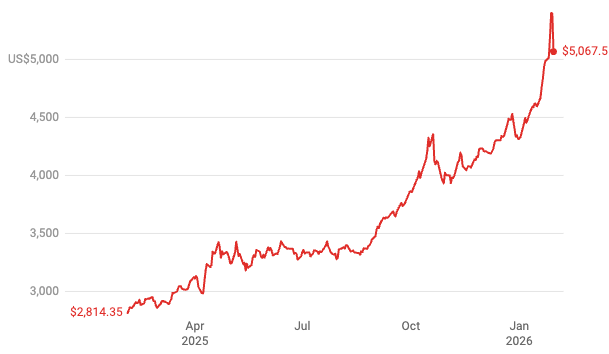
Chart: The ConversationSource: LSEG Datastream
Central banks around the world have been buying gold at a rapid pace, reinforcing its reputation as a place to park value during periods of uncertainty.
But it’s not just big institutions moving the market. In Australia and overseas, retail investors – individuals buying and selling smaller amounts for themselves – have played a part too.
Those individuals have been increasingly treating gold, silver and other precious metals as a hedge against so much uncertainty, as well as a momentum play – trying to buy in to keep up with others.
As prices have trended upward, more everyday investors have bought in, especially through gold exchange-traded funds (ETFs), which make it simple to gain exposure without storing physical gold bullion.
What’s been driving silver’s surge
While gold was grabbing headlines for much of 2025, silver has been the real showstopper. Before Friday’s fall, the metal had surged more than 60% in just the past month, far outpacing gold’s still impressive run of around 30%.
Price of silver, $US per ounce
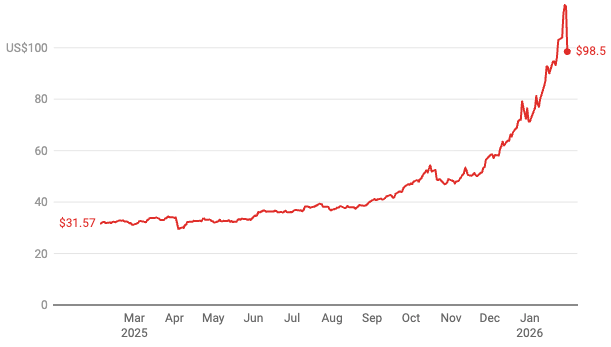
Chart: The ConversationSource: LSEG Datastream
Unlike gold, silver has a split personality. Industrial uses are driving up demand for silver. It’s critical for clean energy technologies, including solar panels, electric vehicles (EVs), and semiconductors.
This dual appeal – as a safe haven, but also as an in-demand industrial commodity – is drawing investors who see multiple reasons for prices to keep climbing.
Every solar panel contains about 20 grams of silver. The solar industry consumes nearly 30% of total global demand for silver.
EVs also use 25–50 grams each, and AI data centres need silver for semiconductors.
The kicker? The silver market has run a supply deficit for five consecutive years. We’re consuming more than we’re mining, and most silver comes as a byproduct of other metals. You can’t simply open more silver mines.
Individual buyers have piled into silver
One of Australia’s most popular online investment platforms for retail investors is CommSec, with around 3 million customers.
Bloomberg tracking of CommSec trades shows how much retail purchases of silver ETFs in particular have spiked higher in the past year.
Over the past year, gold ETF trades on CommSec grew 47%, with cumulative net buying reaching A$158 million. That reflects gold’s established role in portfolios.
Yet despite attracting slightly lower total investment overall at A$104 million, silver trading activity exploded by far more: it’s been 1,000% higher than the year before.
This means retail investors made far more frequent, smaller trades in silver. This is classic momentum-chasing behaviour, as everyday investors piled into an asset showing dramatic price gains.
Australian retail investor trades in gold and silver EFTs, past 12 months
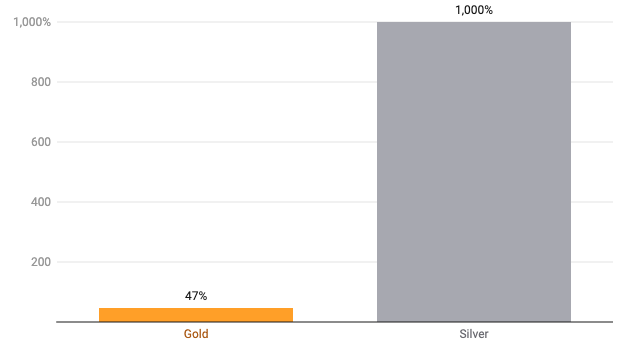
Chart: The ConversationSource: CommSec trades via Bloomberg
The pattern is unmistakable: while gold remains the anchor, silver has become the speculative play.
Its lower per-ounce price, industrial demand narrative, and social media buzz make it particularly accessible to retail investors seeking exposure to the precious metals rally, at a much lower price than gold.
The risks every investor needs to know
The data shows Australian retail investors have been buying as prices rise. But this “fear of missing out” approach comes with serious risks.
Volatility cuts both ways. From February 2025 up to the recent fall, the price of silver had surged 269%. But even before that fall, silver’s spectacular gain had come with 36% “annualised volatility” (which measures how much a stock price varies over one year). That was nearly double gold’s 20% volatility over the same period.
What does that mean in practice? As we’ve just seen, what goes up fast can come down quickly too.
Buying high is dangerous. When retail investors pile in after major price increases, they often end up buying near the top. Professional investors and central banks have been accumulating gold and silver for years, at much lower prices.
No income, higher risk. Unlike shares or bonds, metals don’t pay dividends or interest. Your entire return depends on prices rising further from already elevated levels. And as the past few days have shown, the potential for sharp drawdowns is substantial.
Keep it modest. Precious metals may comprise around 5–15% of a diversified portfolio. After such extraordinary price volatility, that guideline matters more than ever.
Talk to us today if you have any questions about your investment portfolio.


